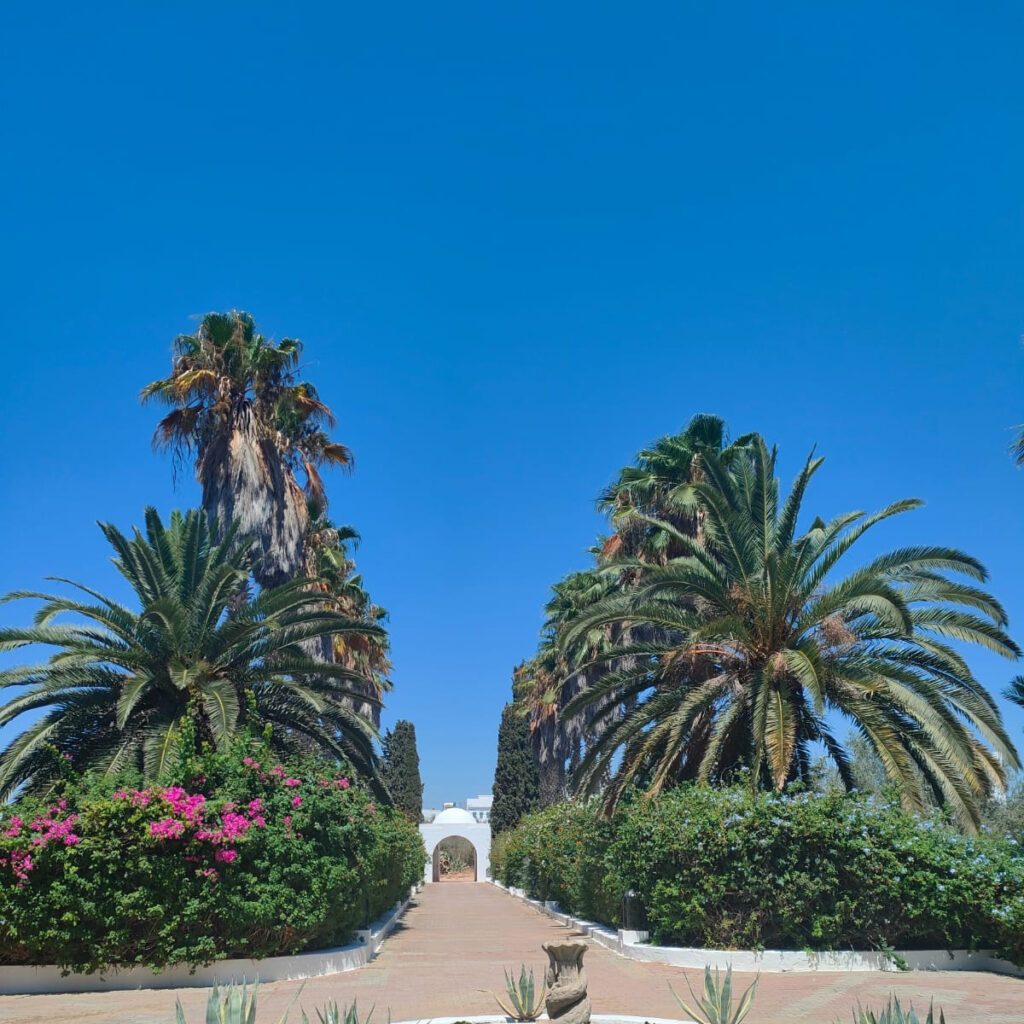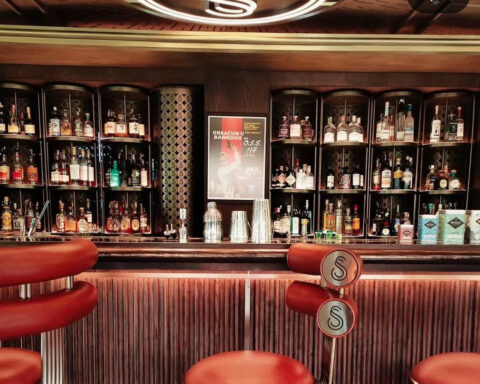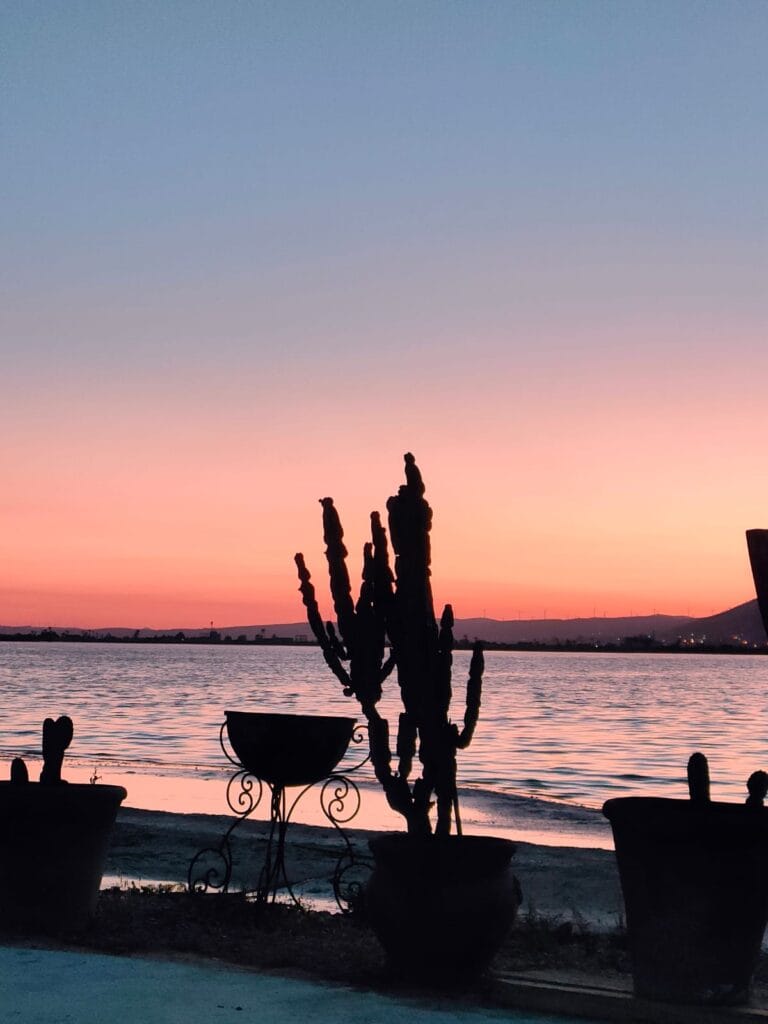
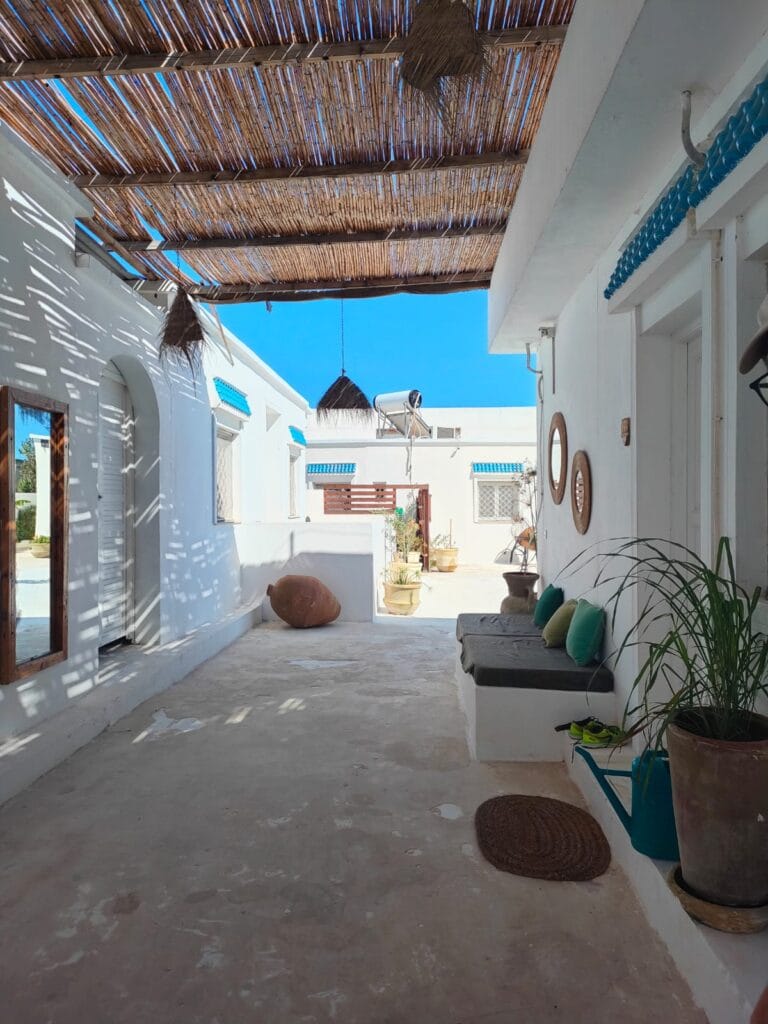
August night, feet on the sand, the voice of Bossa Nova mingles with the rustle of boho curtains. I have just finished a simple dish of grilled fish and parmesan risotto (?), I am at the Cheeky Monkey, an undoubtedly chic guest house in the Raf Raf area, also known as Porto Farina, next to Biserta. Staying between sea and lagoon, at sunset I can thus turn towards Sicily or the Tunisian lagoon hinterland, where the more profane sip pastis. An ancient Phoenician outpost, the land of Cato of Utica, then a den of corsairs and a haven for fleeing moriscos, we arrived in the undisturbed north of Tunisia mainly to visit Bizerte. This region of olive trees, countless roadside roasted corncobs, bountiful orchards and subsistence crops, flows right into the great Tunisian port that had been so strategic in World War II, following the Allied landings of ’42 in North Africa, through the famous Operation Torch. Biserta had been the main supply centre for the Nazi contingent, which reorganised from here to entrench itself in Tunis and fortify its positions. Today, the city is almost a stockpile of commercial containers, with a small, colourful centre reminiscent of vague Venetian Buranian landscapes. However, the entire region holds much more.
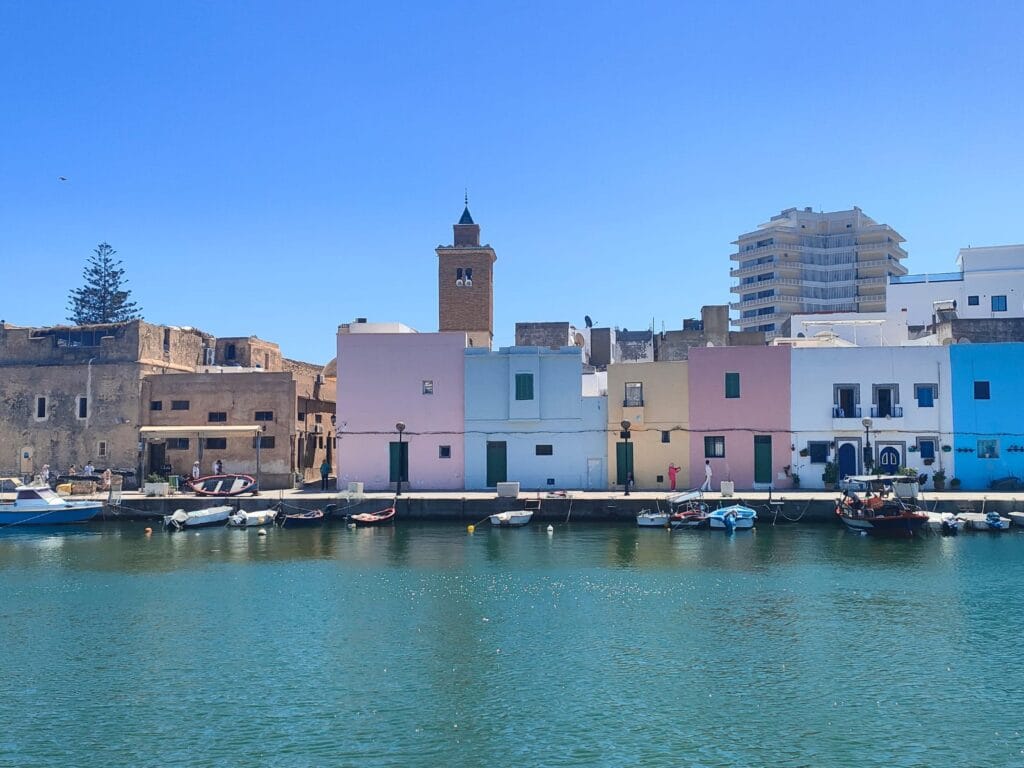
Between the lagoon and the sea sprout a few small islands that can be reached by dinghy, where patrons consume fried fish and gummy noodles on cute stilts, or else under straw huts, sitting on plastic chairs, with a table beside them, to store their snacks, tea and whatnot. Wanting to start categorising, Tunisians at the seaside fall into two types: Either they stay fully clothed, gathered together as a family, more or less far from the crystal-clear water, chatting in low voices under their umbrellas or huts just described; or, at least here in the north, Tunisians of French adoption returning for their summer holidays, stretch out on comfortable chaise longues, sipping alcohol, conversing in both Arabic and French, dressing in the finest cosmopolitan fashion, and daring to wear one-piece swimming costumes and bikinis. The first approach to the sharp division of Tunisian ‘social classes’, about which I think I will want to know more. Meanwhile.. ‘you know, I always tell my son Adam that he is a citizen of the world!’.
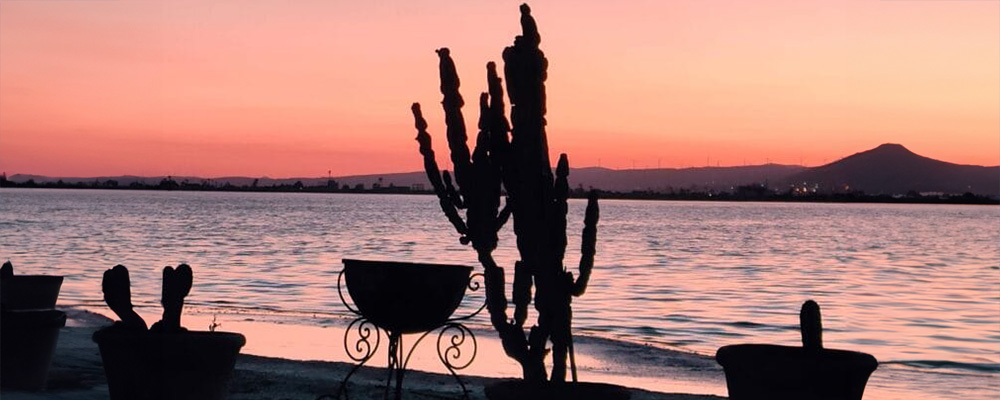
We’re waiting for the sunset, and here he is, popping up with his cute family, the prototype Tunisian born in Paris, stuffed with platitudes, who starts pontificating on solutions to solve the migration issues between North Africa and Europe, declaring himself sorry for our current premier, sure that he instead ‘is on the right side’. Sensationalising the ordinary thing that he is a reader of Le Monde Diplomatique, he believes he draws on solid sources to decide what is right and wrong, criticising the current President Kais Saied, the anti-Arab rhetoric that is taking hold in France, and mocking the inability of Europe and Tunisia to find a fruitful synthesis on poverty alleviation and common challenges. Then he adds: ‘well, I’m going back to Tunisia…I’m going back here for the holidays’! And he completes: ‘I work for a think thank that is supported by the International Monetary Fund’…an old classic, I think, to shoot off your mouth about the impotence of sovereign states, swinging in a hammock at aperitif time in the country of his ancestors, distraught over local Tunisian criticalities, only to reveal that you actually “deem” to works indirectly for the queen of the Bretton Woods institutions. Fortunately, his wife, of Moroccan origin, plays down: ‘we Moroccans live in a monarchy, we don’t care about politics, democracy, those things, the revolution, if you can call it that in 2011, was made by the Tunisians. In Morocco, young people only care about graduating in economics, finance, you know… STEM subjects! In order to find the best employment, hoping to achieve the status symbol, Moroccans like the good life, luxurious cars… the Tunisian elite is much more cultured! They are involved in politics, they study the humanities, they spark debate, they are willing to take to the streets. The Europeans see the Maghreb countries as one block, but we are so different from each other!’
I make an egregious mistake while venturing ‘Well… at first glance your Tunisian and Moroccan cuisines look similar to me, what can I say, is couscous your shared comfy food?’ They both gasp ‘Absolutely not! In Morocco the cuisine is sweet and sour, it abounds with dried fruits, lamb. In Tunisia everything is either too sweet or too spicy, you’ll understand this by finding harissa and mechouia everywhere over the next few days, which is why we extinguish our burning jaws with copious doses of yoghurt, plus the food is pretty much fish on the coast, game in the desert hinterland. Not to mention the tajine, in Morocco it is a stew, here in Tunisia a kind of Spanish tortilla.‘ I apologise, perhaps in those 48 hours I didn’t understand much.
They were thrilled, however, to learn that the next day we would dine at the Golette port, ‘fish in abundance, all kinds, the best supply in Tunisia! You can choose what you like as in the fish market, and then the table is set: boiled, grilled, fried, raw, in France you dream of such things!”
10 August
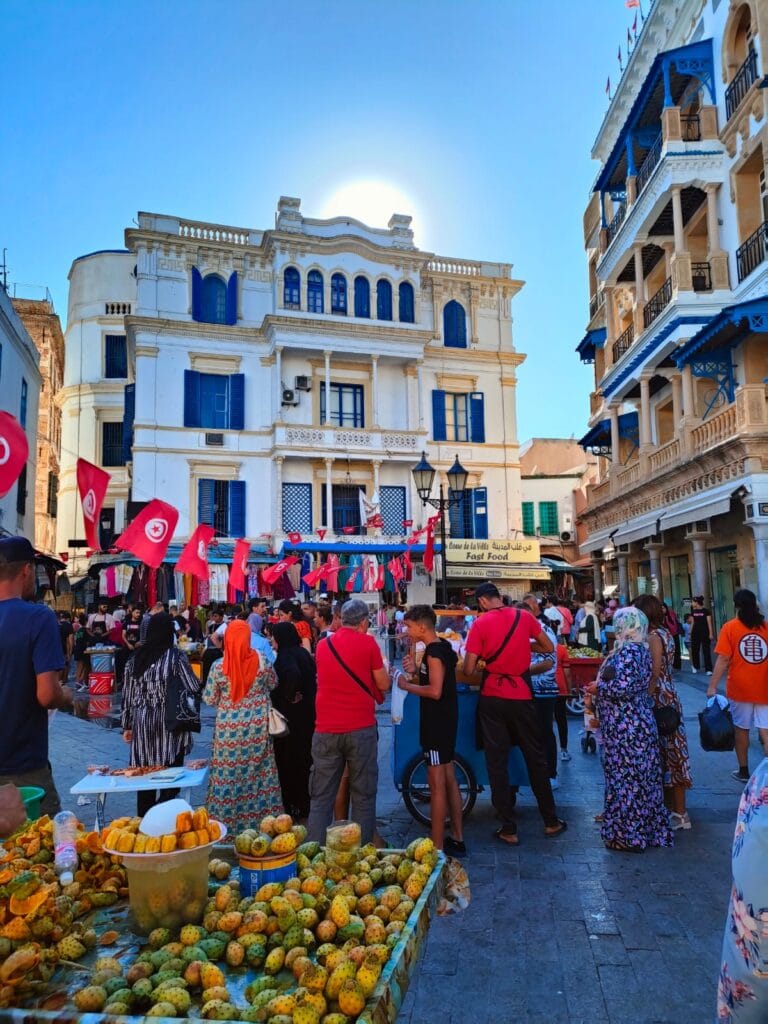
It is already time to leave the Cheeky, we have almost become family, it feels like like leaving a commune. The dog, the five-year-old daughter of the owner with the golden curls, has already become attached to us and asks pour quoi allez a Tunis? No one remembers to let us pay for our stay. The fear is that this eden between sea and lagoon, has been the last comfort before the journey to the Pillars of Hercules. We get back on the road. We have to head back towards Tunis, along the Mediterranean, and arrive at the old port, the Golette, for dinner. After a bit of hesitation, we choose to take the normal route, to see the hinterland. After an hour’s column, we finally take our diversions. It is already evening, and we drive along the similar provincial road that connects the two major towns of Kelat el Andaluus and Raoued. In the middle there is almost nothing, just a barren, uniform expanse, the street lamps off, then a roundabout, an off-road stopped by the wheeled controls of the military police, who randomly inspect someone every now and then, as they enter and leave the settlements. Nothing threatening. I lower the window to lean out my arm, I like to dig into the summer wind to smell the scent, the velvet, but the piles of rubbish cancel out what I expect to encounter again, the beloved aroma of the Mediterranean scrub. Rubbish is everywhere, undisturbed, in and near the sea, next to or on crops, poisoning the magic of the splendid Tunisian nature. Like intruders, we end up in villages, or rather, in settlements built on the sides of roads or around roundabouts, noticing houses begun but never finished, women completely covered with children in their arms and following them, men-only bars, butcheries with hanging slaughtered heads, apparently indicative of the freshness of the day’s meat. In the ring roads, pick-ups, trucks, and self-styled open-air markets 24/7 sell huge watermelons, yellow melons, prickly pears, grapes, they haggle even at night. At one point we speed past a mosque, there is a big crowd, ‘let’s get out of here’ I think to myself. My co-pilot asks us to slow down, something very strange is going on. In the centre of a large semicircle two horses at a trot are carrying two children, one with long black hair, onlookers are applauding around, will it be a village festival, a rite of passage? “Let’s go”, I say.

We arrive late at the port of la Goletta, having passed the resorts of Gammarth and La Marsa on our way into the capital. The plan was to arrive fairly early, as we have to get back to the Medina for the next night and after 11pm it is not recommended to circulate within the old walls. Instead, we are late. We arrive in the midst of the chaos of the Goletta, passing through the old 16th-century Spanish walls. It’s true, fresh fish restaurants are swarming all over the place, the price is ridiculously low, there are all kinds of fish and in huge quantities, almost as many illegal parkers, blocking the passage and the traffic, along with the flood of people. My co-pilot is going crazy.
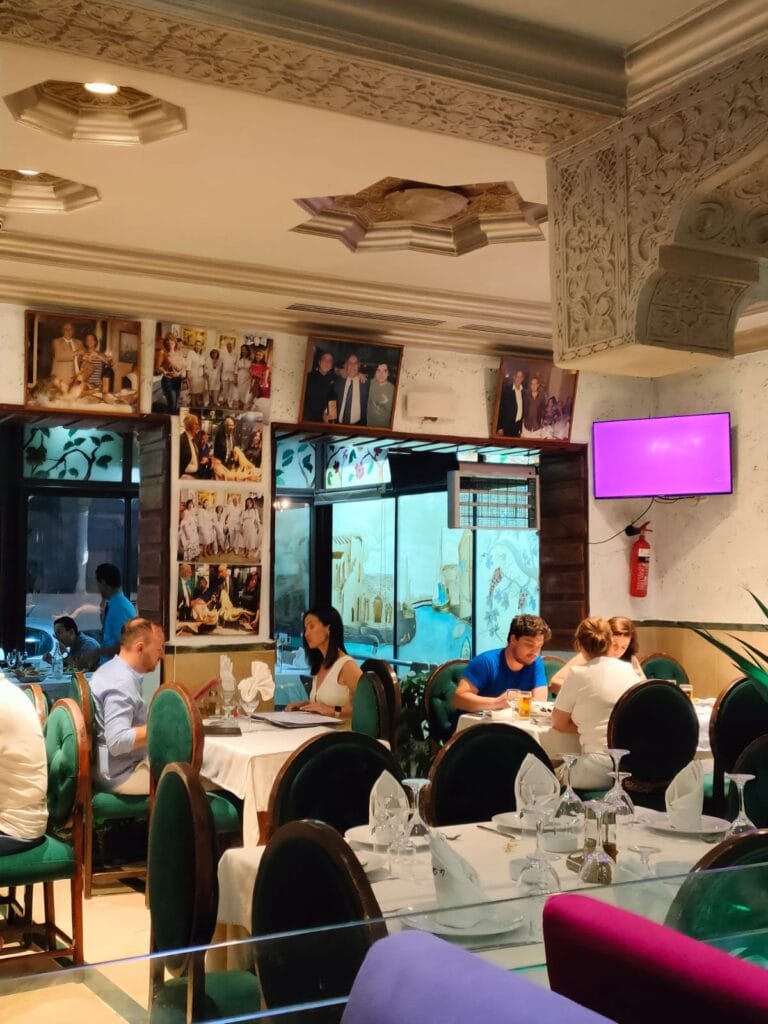
After all, the Goletta is one of the most characteristic ports in the Mediterranean; it is very similar to our south. In fact, Claudia Cardinale was born here and in 1957 she was also elected the most beautiful Italian in Tunis. Starting in 1868, with the Treaty of the Goletta, a real wave of Italian migration changed the physiognomy of the city. The Italians, for the most part Sicilians, founded a chamber of commerce, the branch of the Banca Siciliana, the newspaper ‘L’Unione’, theatres, cinemas, schools, hospitals, the ‘Little Sicily’ district was born. If the Italians in Tunisia numbered some 25,000 in 1870, they reached 89,216 at the 1926 census, thousands of whom lived at the Goletta. From 1964, unfortunately, their property was expropriated, and having only French passports, the Italians in the Goletta headed for France, joining the Algerian pied-noirs. What remains of all this are dilapidated period buildings, with a few Art Nouveau friezes, rutted streets, and our Spigola, the most famous restaurant, where Bourguiba seems to have been a regular, at least as evidenced by the countless photos papering the walls. I still think raw food is dangerous, we order a sea bream, some fried turbot, followed by the usual bread serving, ‘why is it the same everywhere?’, I question myself. Later in the trip I would understand. The service is excellent, we are in the classic iconic restaurant of a seaside town..
We are now in Medina, with our usual three suitcases, everyone has retreated indoors, not a fly flies, it is dark. I am afraid. Finally, a large monumental doorway shows up, there is a small, almost medieval entrance door, the gatehouse of the Dar Ben Gacem opens, our shelter for the next two nights, it is beautiful, it even boasts a quiet terrace overlooking the roofs of the Medina. Our welcoming usher escorts us to our room offering a fresh lemonade, shukran. All is sound silence, the Medina night is a fatal, magnificent, irresistible oblivion.