ore 12.30, Cafè Cortado – Gemmayzeh
12.30 p.m., Café Cortado – Gemmayzeh
I was reading the pages of L’Orient-le Jour, convinced I was brushing up on my already largely forgettable French. I was sipping an espresso at the café Cortado, a cosy corner for expats in search of third-wave-of-coffee atmospheres, or perhaps already fourth. Me, Maria Chiara, a particularly fit American guy, a girl with Asian traits and the classic coffee-lover barista ‘just back from a competition in Italy’. It was late, I was quite nervous. I tried to take a special interest in an article over the reconstruction rackets in Aleppo, not to consider how late we were. The plan for the day was to wait for Hassan around 10am, so as to head south to Tyre and Sidon. When, due to a mishap, his car was no longer available, I had scrambled to demobilise the receptionist to see if any rental cars was still available. Some kind of cliché situation arose: perhaps a friend of a friend of his brother’s (I still keep to this day the whatsapps of the whole chain of acquaintances) might be able to find a car. No luck. That’s why we then went out for coffee. The fit American gymnast helped us communicate with Mike Rental Cars, a ‘very reliable’ car rental company. When I had already given up hope, Hassan told us that he would be there to pick us up at late noon, saving our already compromised day! We set off.


To reach the south of the country we headed towards the airport road, merging in the road anarchy of the settlements just outside the city. We skirted the coastal town of Damour, now a string of banana trees, which in the distance was hardly reminiscent of the famous massacre. On a night in January 1976, during civil war, PLO military units had slaughtered some 500 Christian Maronites, provoking the sudden retaliation at the Palestinian refugee camp of Al-Quarantine. In 1982, instead, the worst would have happened as a consequence of the murderer of Bashir Gemayel, leader of the Phalangist militia. The Phalangists and Israeli forces jointly carried out an atrocious massacre at Sabra and Chatila refugee camp, in order to revenge the episode. Perhaps it does not even make sense to report these stories, without taking care of perfectly reconstructing any specific background and the precise chain of events. Maybe not even History would be able to provide us with an unbiased overview today? As I drove along that coastal road, all I thought was how that brutality could have materialised in such a beautiful country.
Thoughts that were sweetened by the short lunch break near Sidon (Saida). ‘In Saida you eat the best knafeh in Lebanon,’ said Hassan. Widespread throughout the Middle East, with several variants also in the Balkans, Greece and Turkey, this mouth-watering dessert is prepared on large circular plates, placing on a base of sugar syrup a hearty layer of stringy cheese covered with phyllo dough or semolina and a light sprinkling of pistachios. In Lebanon, knafeh is also eaten as street food, sandwiched between two slices of sesame bread, and so we tried it. Exquisite! We were ready to cross the city centre and its wrong-direction cars on one-way streets, soon we would arrive in Tyre, still 40 km to go.


Tyre
We were on our way downhill, welcomed by a wonderful light on the horizon, decorated by thick vegetation, banana plantations and cedar trees. The ‘Queen of the Seas’, the epithet given to this thousand-year-old city, whose main archaeological sites, Al Bass and Tyre city (Sour in Arabic), were discovered in 1947 by the Lebanese Antiquities Department. Excavations at Al Bass unearthed hundreds of sarcophagi from the extensive Phoenician necropolis, a triumphal arch, an aqueduct and the second largest hippodrome in the world (dating from the Roman to Byzantine time). The mosaics, streets, colonnades and public baths of Tyre reside in an area that was once located on a series of islets, later connected to the mainland. The city was a thriving and impregnable port, so much so that it took Alexander the Great six months of siege to conquer it. It had taken us about half an hour’s long walk to locate the hippodrome only to look out at a weed-filled gate and spot the site in the distance. Once we entered Tyre city, meddled in a normal day in an Arab city, where archaeological observation gave way to the twisted alleys of the Muslim quarter, the clothes hanging, the flowers, the children playing in the street, the fishermen’s scarred faces, the ladies kissing the bust of St. Maron reciting prayers just after lunch. We had arrived in Tyre at siesta time, when all was muffled by sleepy rhythms. We sneaked into the open patronage of the Archieparchy of the Maronites, to the public market under the Roman walls, and then floated into the sunshine of the open sea at the harbour.


Tiro resembled Pellestrina (an island on the Venetian lagoon), any small port on some Greek island, a true Mediterranean harbour where fishermen would gather to play cards on plastic tables, to pound freshly caught octopus, and where the diesel of the city rush was tempered by the sea breeze and the smell of grilled fish. A few commemorative plaques broke the spell, evoking the shadows of the 2006 war and paying tribute to the forces of the Shia paramilitary group Hezbollah (‘The Party of God’), which ‘heroically fought the Israeli enemy in the streets of Tyre’. Tyre is the city located just a few kilometres from the Israeli border, from its twin city of Acre, which Hezbollah defended against enemy incursions. Only part of the Lebanese population still considers them as heroes. Not only they are even represented in Parliament, but in Mleeta, towards the Beeka valley, there is even a ‘Museum of Hezbollah and the Lebanese Resistance’, dedicated to them.


We moved to the beach for a swim, where we were the only women in bikinis. Of that afternoon on the seashore talking to Hassan and my travel companion I remember one meeting: I was already planning our itinerary for the next day, it would have been to Deir El Qmar, Beiteddine and Baalbek. But indeed, there were no buses, no uber, no means whatsoever to get there. I kept wanting a car. Down at the beach bar I met a girl with whom I had chatted around about the brotherhood of Mediterranean peoples over a fizzy drink. Out of nowhere her brother popped up, a certain Y. Husseini, a bit excited, who offered to give me his 4×4 car for free for the rest of our holiday. “But..if I crawl?” I asked. “Don’t worry, I have insurance-insurance” said Y, “but..if they stop me at any checkpoint and I can’t justify where the car comes from, no-rental-car no-rental-car option?” (I started repeating the words twice just as him). “You call me, this is my number, you say you’re my girlfriend and it’s OK. That’s the habit in Lebanon, I always lend the car to my friends. Besides, they won’t stop you, because I have governmental plates”. Hassan later confirmed that yes, that was the way it was in Lebanon, even though that guy also seemed to him a blowhard. Obviously, Maria Chiara was ready for the adventure. I was a little less so, as I had just ascertained the size of the car we were going to borrow (a Range Rover with giant tires) and had immediately mentally placed it in the busy roadways we had travelled so far. We exchanged numbers and had a round of shots at the counter, I don’t remember the exact reason, but “we had to celebrate!”
Sidon
We arrived in Saida at sunset, fresh from an afternoon at the beach, dried out from the sun and smeared with salt, hungry like any adorable evening back from the sea. As Sidon was another city of Phoenician memory, I wanted to see the Crusader fortress that has stood on the harbour since the 13th century; I wanted to check the Al Omari mosque, built by the Mamluks in the 14th century on the remains of the church of the Knights of St John; the city’s day market, scattered in the tangle of ancient caverns and tunnels that enliven the old city; the imposing castle of St. Louis, built by the Crusaders during the 13th century on the ancient acropolis of Sidon, towering over the port and the walled city, surviving the Mamluk pillage and Ottoman rule, dented by the Lebanese civil war and the more recent conflict with the Israelis (2006); the Debbane Palace Museum, built in full Ottoman style by Ali Hammoud in 1721 and now open to the public.
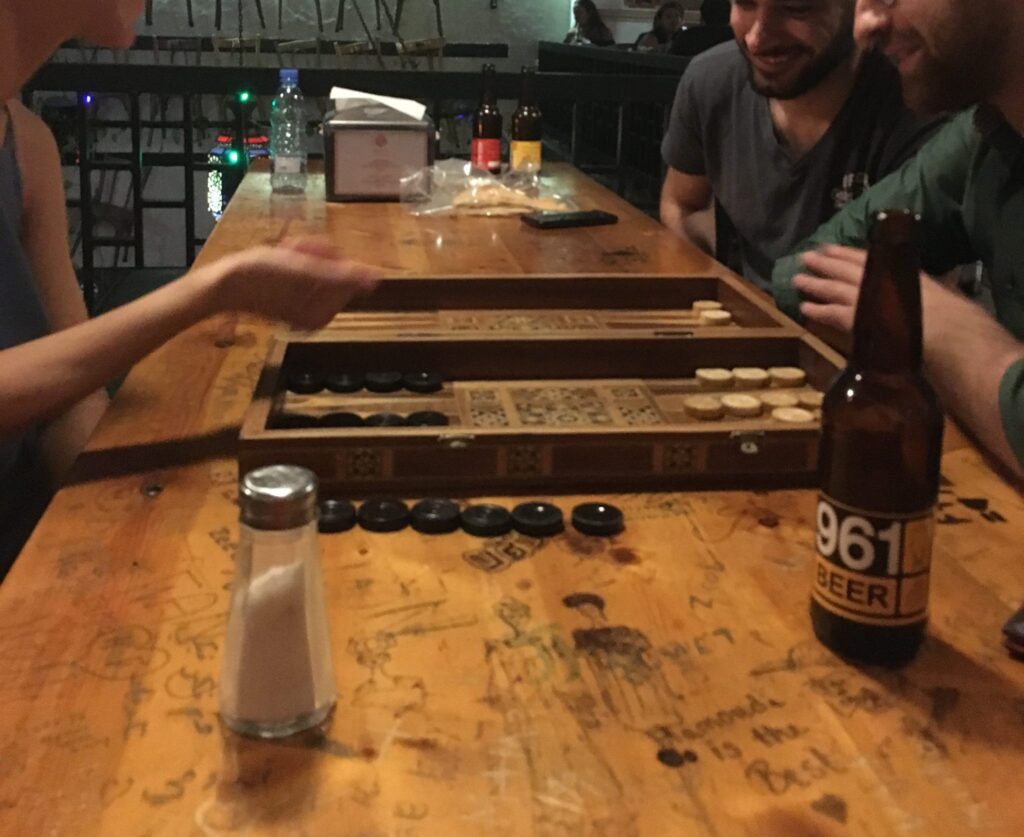
There was actually no time to see anything at all, and I was incredibly not angry for that. Perhaps I would visit them one day, when I would surely return to Lebanon. It was now evening, the main sights were closed, We enjoyed the dusk at the harbour, where lazy, swaying fishing boats were resting in front of the crusader castle. At the entrance to the old town, a few taverns served good fish to backgammon players, and arak (aka ‘the devil’s milk’) deflated the palates of the patrons of those homely establishments, where a few innkeepers invited us to feast.
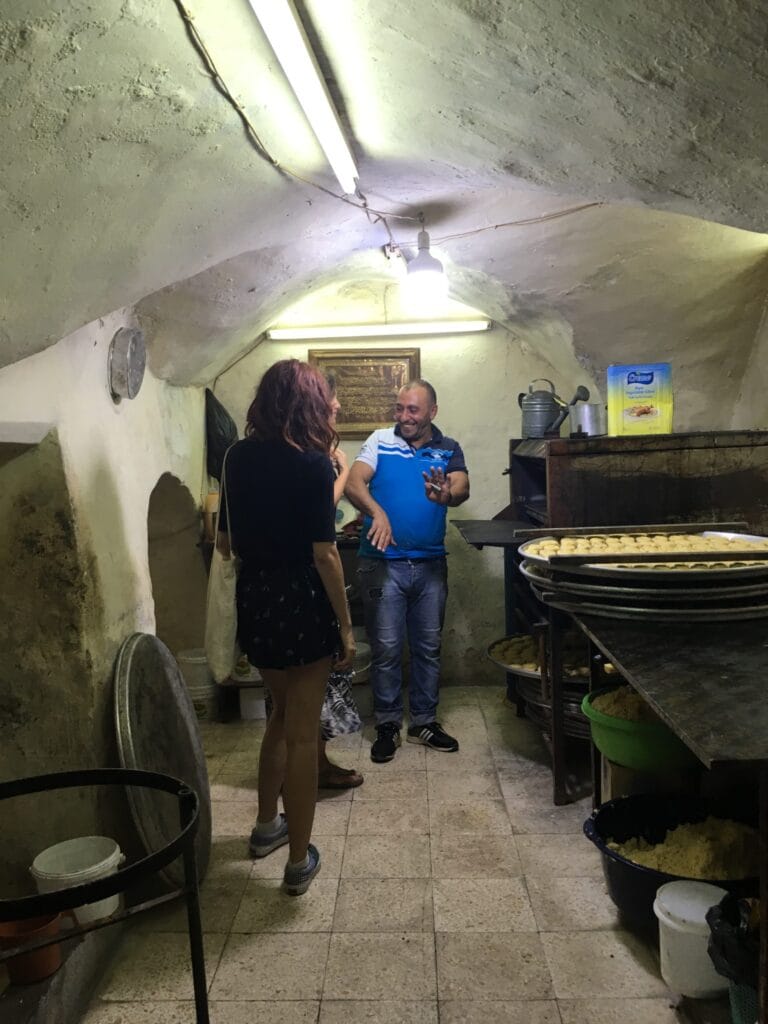
We wandered through the sleepy, deserted streets of Sidon old town, illuminated by faint lights, which made the atmosphere entirely medieval. In some of the courts, women were preparing food on long tables, and some confectioners and bakers were churning out almond, pistachio and date sweets with an uplifting aroma. It was 6 August, and we discovered that we had stepped, like three ghost guests, into the everyday scenes of a special occasion: the period of the Hajj, during which the Islamic faith envisages a pilgrimage to Mecca. As I remembered when reading Ibn Battuta’s ‘The Journeys’, in the Islamic calendar the Hajj begins on the eighth day of the lunar month ‘Dhu al-Hijja’, the last of the Islamic year, and ends on the thirteenth day of the same month. Instead, the same pilgrimage to Mecca, made in other months of the year, is called ‘Umra’. It is a fundamental moment in the life of the Muslim believer, one of the five pillars of the faith. We had been given the fortuitous opportunity to learn about the rituals and the family traditions that this important moment marks in the lives of the people of Sidon. A baker invited us to taste freshly baked date sweets, showing us all that he had prepared for the next day, and he was very keen to give us a bag of his decadent pastries. Later, as muezzin was calling for prayer, we came upon the Khan al-Franj Caravanserai, built by Fakhr al-Din in the 17th century, the best preserved in Lebanon. It was one of those evenings when, as a traveller, I felt as becoming one with the places that welcomed me, deliberately listening to the stories that I thought I could hear exclusively, in an exclusivity that made me drunk with curiosity, grateful and vaguely convinced that I had been chosen to be able to see, to discover them. As if those same places had chosen to show themselves only to me, in that moment.
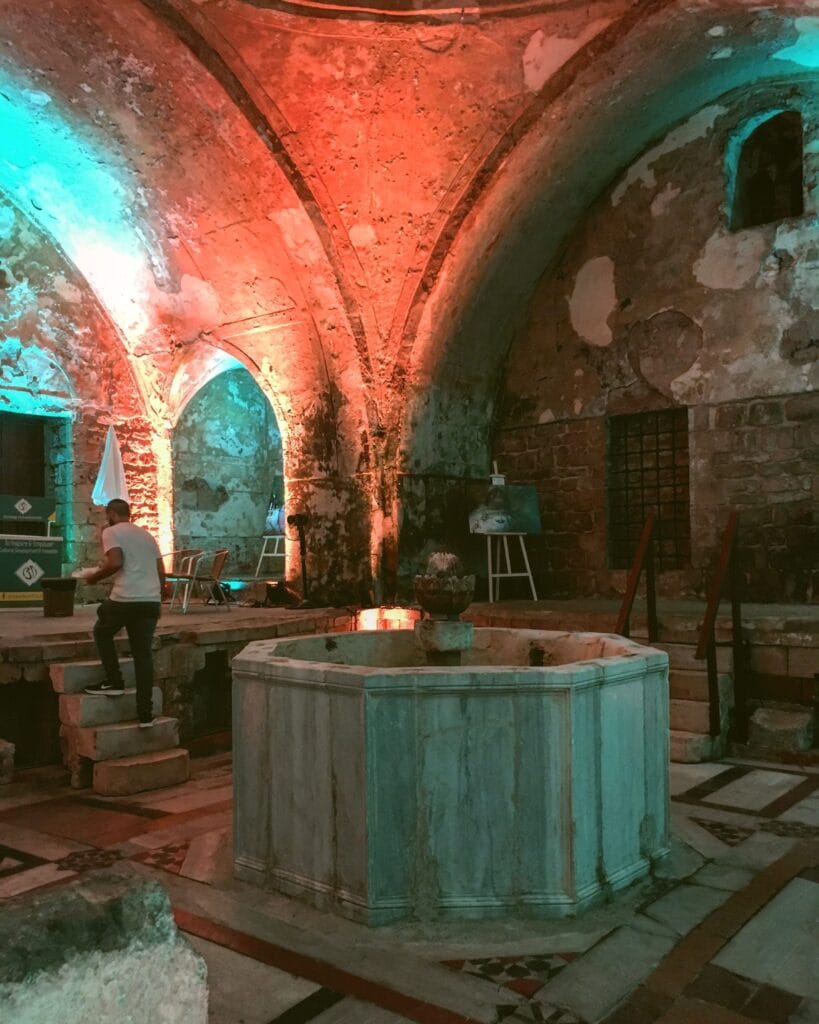

We had accidentally entered an old Ottoman hammam, recently discovered and opened to the public. In there was a certain Jean Pierre, an elderly archaeologist who glowed with enthusiasm at the idea of transferring his precious knowledge to three finally interested passers-by. Although covered in thick encrustations of mould, the hammam still had its marble floors perfectly intact, it looked like a place that had only been abandoned for a few weeks. The archaeologist explained to us that restoration work in Lebanon was only carried out by private foundations, that the government did not dedicate state funds to the recovery of these places, devoured by the horror of war and forgotten by the survivors. But I thought after all, selfishly, that perhaps it was for the best: I would never have wanted Sidon to become the destination of blind and hasty visitors, it would not have deserved it. Perhaps beauty does not have to captivate and give itself to everyone. What if only the inhabitants of Sidon had the right to experience, contemplate or ignore it? In that case, Mary and I had only been two intruders, involved by the Case.
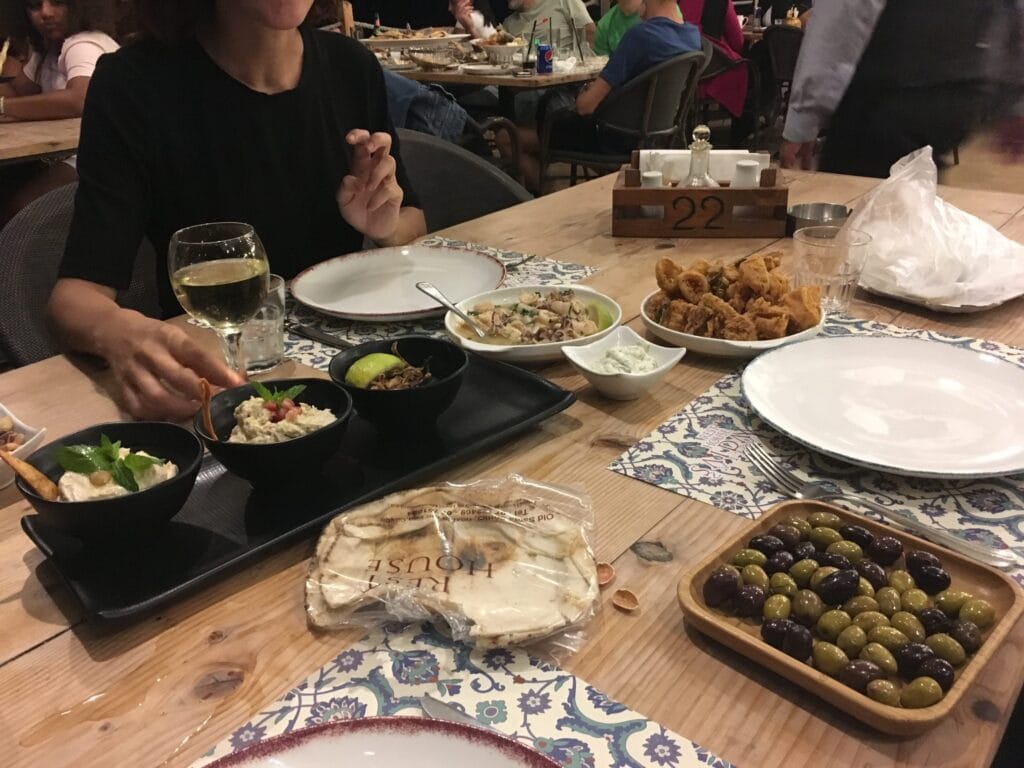
The same Case led us to the Saida Rest Restaurant, the headquarters of the Rotary Club of Sidon. Seated at a table by the sea, overlooking the crusader castle, we spent the rest of the evening over two courses of fried and grilled calamari, talking about the day’s frenzy, oblivious to the course of time, happy to be lounging placidly in the maritime coolness of that summer night. Without knowing if the three of us would ever meet again, we were questioning ourselves how we ended up sharing a day trip to some thousand-year-old Mediterranean town, after an accidental meeting on an Air Serbia a couple of days before. In the end, it didn’t matter. Lebanon did not respect my plans, it unnerved, displaced and repaid me with such generosity, giving me the fullness of those first days, as if it wanted to give me a lesson in contemplation, to arrest my impatience. I was happy to be the wrong person for a place where nothing was right, I began to feel at home.